Call020 4520 0212 Emailinfo@epsomcoachhire.co.uk Quote within the hour
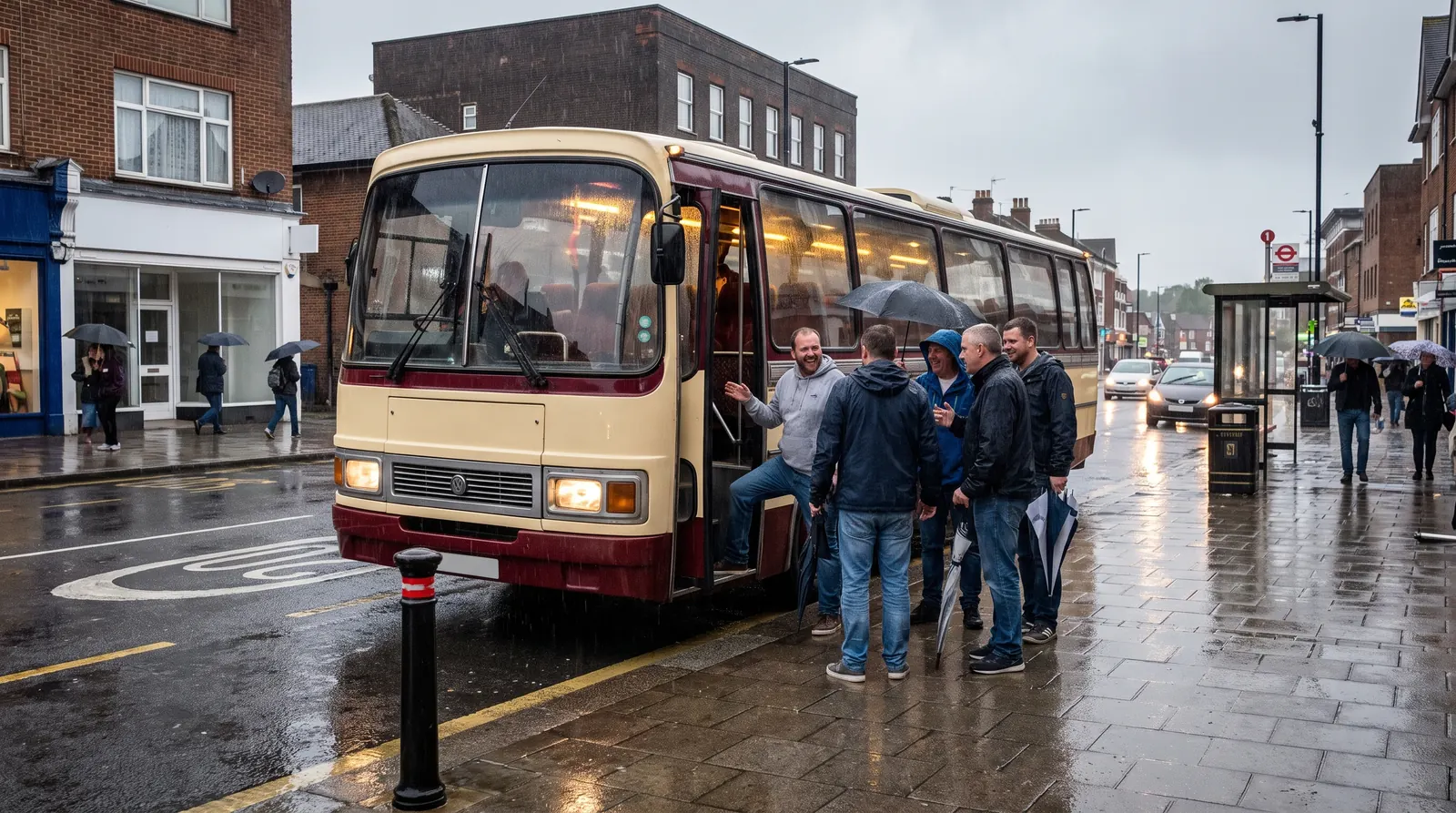
A cream and burgundy coach at the kerb on Epsom high street in the rain, a group boarding under umbrellas

Coach & minibus hire · Epsom KT17, KT18 & KT19

Coach hire in Epsom, where the coach is part of the tradition

The Downs, Derby Day, school trips, airport runs and days out along the Surrey side of the M25. Sixteen to seventy seats with a driver, quoted within the hour by a person.

OutsideThe London zones
16–70Seats
1 hrTypical quote

Get a price

A few plain questions. Quote within the hour, no obligation.

Your journey and how to reach you
A street, a school, a pub — whatever the group knows it by.
Is it a return trip, or one way?
When do you need the coach?
And coming back?
How should we reach you? Either is fine — we only need one.
Read this before you compare quotes

Epsom is outside the London emission zones

Almost every town we cover is inside Greater London, and on those pages this section is about paying the charge. Epsom is different, and it is worth being precise about why.

Epsom is in Epsom and Ewell Borough Council, in Surrey. It is not a London borough. The Ultra Low Emission Zone operates across all London boroughs and does not extend here; the Low Emission Zone covers most of Greater London and does not extend here either.

But the journey usually does cross the line

A pick-up in Epsom is outside the zones. A trip that runs into London is not. The moment the vehicle crosses the boundary — and from Epsom that is a few minutes up the A24 or round the M25 — the ordinary rules apply: coaches and minibuses over 5 tonnes come under the LEZ and must meet Euro VI or pay £100 a day; minibuses up to and including 5 tonnes come under the ULEZ at £12.50 a day if they do not meet the standard.

Our vehicles are compliant either way, so nothing is passed on to you. The reason to say all this out loud is that a quote which is cheap because the operator has not thought about the boundary is not actually cheap.

Zone rules and boundaries are set by TfL and change. Checked against tfl.gov.uk on 29 August 2026. We confirm the position for your vehicle and your route when we quote.

The reason most people ring

Epsom Downs, and what the racecourse actually says about coaches

Most towns on our books tolerate coaches. Epsom is one of the few that has built a tradition on them, and The Jockey Club publishes the arrangements rather than leaving you to guess.

“Buses and coaches are an integral and hugely traditional part of The Betfred Derby Festival experience and are renowned as a great way to soak up the day, whether it’s a family get together, a birthday celebration, a hen or stag do, a company day out, or client entertaining.”thejockeyclub.co.uk · checked 29 August 2026

A booked coach comes with access to the Upper Tattenham Enclosure, no parking to think about, and permission to bring your own food, drink and furniture — parasols and chairs included. That is a genuinely different proposition from turning up in cars.

Where to set down, in their words

“For pick up and drop off, please use Car Park 8, outside the Derby Arms Pub, and please do not use the roundabout to exit or enter your vehicles.”thejockeyclub.co.uk · checked 29 August 2026

The second half of that sentence is the one people ignore, and it is the one that causes the queue. We use Car Park 8 and we do not use the roundabout.

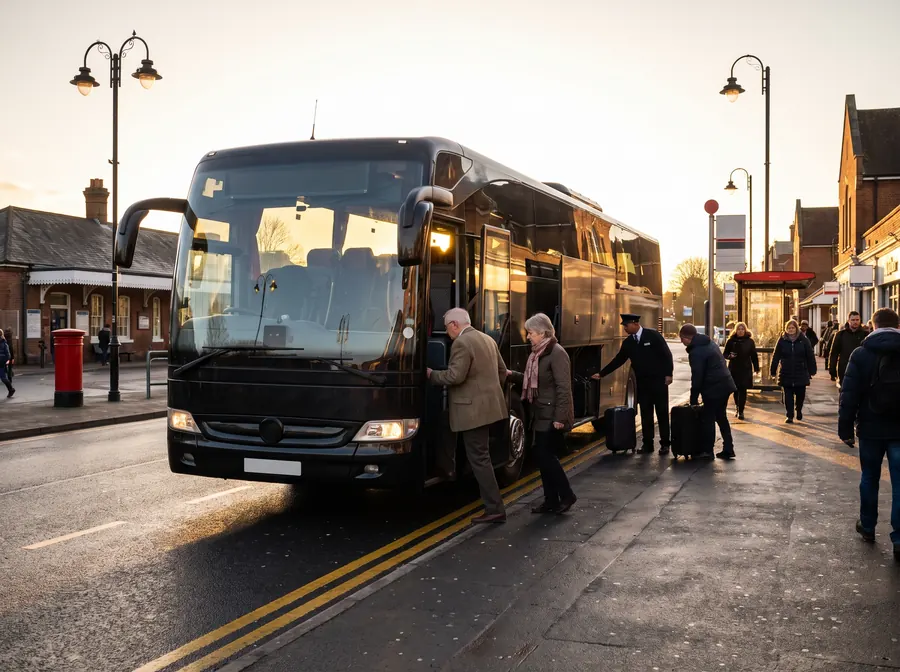
A black executive coach in golden late-afternoon light outside Epsom station, an older tour group boarding while the driver loads a case
Race days aside, the steady work here is the unhurried kind — groups who would rather the driver handled the cases.
  • Group discounts start at six tickets or more in selected enclosures, so the coach and the tickets are worth booking as one decision rather than two.
  • Three stations serve the course — Tattenham Corner, Epsom and Epsom Downs — which matters if half your party is coming by train and half by coach.
  • Car parking is free across the Festival, but is recommended to be arranged in advance if you want a particular spot. That is for cars; the coach arrangement is separate.
  • Shuttle buses run from Epsom railway station to the town centre on Festival days, £3 single and £5 return — useful for stragglers, not a substitute for the coach.
What people hire us for

Groups coming to Epsom, and groups leaving it

Race days

The Derby Festival is the big one, but the course runs meetings through the year and a coach is the civilised way to do any of them. Car Park 8, and back to the same spot.

School trips

Epsom sits close to the North Downs, Box Hill and the Surrey Hills, so an outdoor day is twenty minutes rather than an hour. DBS-checked drivers and seatbelts throughout.

Airport transfers

Gatwick is the near one, straight down the A217 or the M23, and it is one of the shortest airport runs on our books. Heathrow is round the M25 the other way.

Weddings

Guest shuttles between church, reception and hotel across Surrey, where the venues are often a village apart and the lanes are not built for fifty cars.

Days out to the coast

Brighton is an hour and a bit from here, which makes Epsom one of the easier London-fringe towns to run a seaside day from.

Golf and club fixtures

Surrey has more golf courses than anywhere else in England, and society days end with people who should not be driving. That is exactly what a minibus is for.

The practical bit

Where a coach can actually wait

Epsom town centre is a narrow, busy Surrey high street with a one-way system round it, and the Downs are a mile and a half up the hill. The two need different answers.

  • Epsom station — the sensible meeting point for a group arriving by train, with proper road access and space to stand a vehicle briefly.
  • Car Park 8, at the Derby Arms — for anything at the racecourse, because that is where the course itself puts coaches.
  • The Downs road, away from the crowd — on a meeting day the approach roads fill early. We plan the pick-up time before the day rather than ring when the last race finishes.
  • Not the town-centre car parks — they are car parks in the literal sense. A coach sets down on the street and leaves.
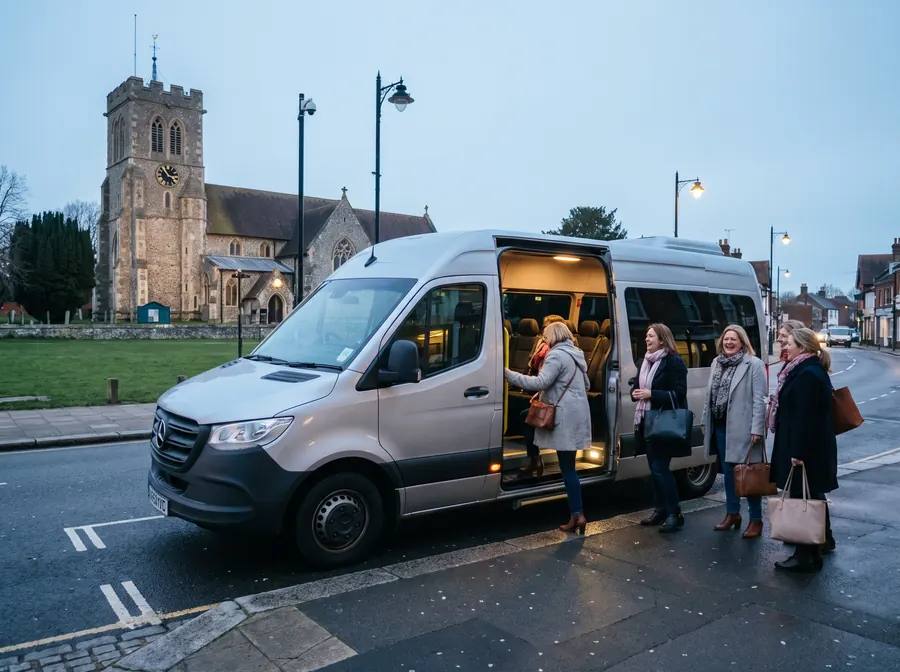
A silver minibus at dawn beside a parish church in Epsom, street lamps still lit, a group of women boarding for a day out
Early starts are normal here. A six o'clock pick-up for a coast day is a quieter town than most people have seen it.
The bit nobody publishes

Thirty height limits, and six stop even a minibus

We plan around three heights, not one: a 16-seat minibus at 2.8 metres, a full 49 to 53 seat coach at up to 3.9 — a Mercedes-Benz Tourismo measures 3.68 with its roof air conditioning and a MAN Lion’s Coach 3.87 — and a 70-seat double-decker at 4.4. Worked that way, six of the thirty stop even a minibus, fourteen stop a full coach and twenty-one stop the decker outright, with a twenty-second — Cheam Road, two and a half kilometres north-east — signed at exactly 4.40, which for a 4.4-metre vehicle is the same thing. Here are the ten lowest, chosen because they change a route rather than because they lengthen a list.

The ten lowest signed height limits on roads near Epsom, in metres and imperial, and which of the three vehicle heights each one stops
RoadLimitImperialWhat it stops
Queen Mary Close2.00 m6′6″All three, minibus included
Doghurst Lane2.50 m8′2″All three, minibus included
How Lane2.50 m8′2″All three, minibus included
Coulsdon Lane2.50 m8′2″All three, minibus included
Angel Road2.70 m8′10″All three, minibus included
Elm Road2.74 m8′11″All three, minibus included
Ewell Road3.35 m10′11″Coach and decker
Sandown Road3.50 m11′5″Coach and decker
Chipstead Valley Road3.50 m11′5″Coach and decker
Grange Vale3.50 m11′5″Coach and decker

Six lanes under 2.75 metres is a lot for a town this size, and it is the Surrey answer: these are old lanes under old railway arches, not modern roads. Elm Road and Angel Road, roughly seven kilometres north and north-west, are the two that turn up on ordinary out-of-town jobs rather than only on a race day. Below them the fleet starts to split: Ewell Road at 3.35 and the three at 3.50 stop every full-size coach on our books, and a 16-seater goes under all four with better than half a metre to spare.

Four more sit in the narrow band between 3.68 and 3.87 metres, where “will a coach fit” genuinely stops having one answer, and one of them is the nearest signed limit to the town centre of all thirty. West Hill, at 3.80 metres, is about 350 metres from the middle of Epsom; Cobham Road at 3.70, Salvation Place at 3.73 and Shorts Road at 3.81 are all roughly seven kilometres out on the radius. A 3.87-metre MAN Lion’s Coach fits under none of the four. A 3.68-metre Mercedes Tourismo fits under all four. That is the level at which we ask which coach is on the job before we route it, rather than writing the whole band off.

Road heights from OpenStreetMap contributors, ODbL. The verdicts are our own, computed from each signed limit against the three vehicle heights above — Mercedes-Benz Tourismo 3.68 m including roof air conditioning (mercedes-benz-bus.com) and MAN Lion’s Coach 3.87 m (lectura-specs.com), both read 29 August 2026, with 3.9 m taken as the worst case for a high-deck single-decker. The search radius reaches into Banstead, Coulsdon and Chipstead, so some of these are over the Surrey border into Croydon — a bridge does not care. Signed limits change; a driver should always trust the sign over any list, including this one.

The fleet

Sizes we run from Epsom

16
Minibus
24
Midi coach
33
Midi coach
49
Full coach
53
Full coach
70
Double-decker

Every job comes with a professional driver. For the Derby the double-decker earns its keep in a way it does not anywhere else on our books — an open top deck at a racecourse is the whole point of the tradition.

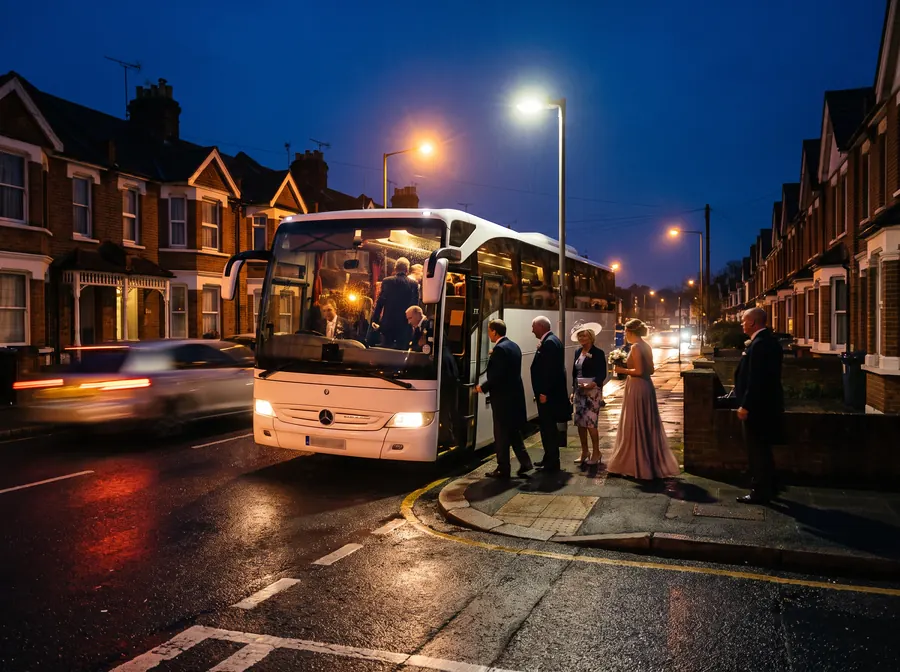
A white coach at night on a street of Epsom terraces, a wedding party in formal dress boarding under streetlights
Surrey weddings run late and the venues are spread out. One vehicle, one late pick-up, and nobody drives.
Epsom Downs Racecourse · the Derby Epsom Playhouse · town centre Nonsuch Park · Ewell Box Hill · 20 minutes Gatwick · the near airport Brighton · just over an hour
Salts, springs and a horse race

Epsom was a spa town before it was a racecourse, and the water is why

The name is on a bathroom shelf in half the houses in Britain, and the reason is a field on the common.

We drive into Epsom most weeks and it is easy to read it as a commuter town with a racecourse attached. It is the other way round: the racecourse is a by-product of what brought people here in the first place, which was the water.

A cow’s hoofprint

Around 1618, in a dry summer, a herdsman named Henry Wicker was watering animals on Epsom Common and found a trickle of water standing in a hollow cow’s hoofprint. He dug a square hole around it and took the cattle home. They would not drink from it. The water tasted of minerals, and thirsty animals knew better.

Wicker tried it himself. It was bitter, and when it evaporated it left a salt with a decidedly memorable effect — it was a laxative. In 1695 the chemist Nehemiah Grew isolated the substance and gave it the name it still carries: Epsom salt, hydrated magnesium sulphate. A local apothecary, John Livingstone, did the rest, promoting it nationally and sinking new wells nearer the town.

So a bathroom-shelf staple in half the houses in Britain is named after a hole a man dug round a hoofprint on this common. People then came for the cure, and where a crowd gathers with time on its hands somebody organises a horse race. The spa made the crowd; the crowd made the racing.

What that left behind

A town built around visitors rather than residents. Wide approach roads to the Downs, a high street that has been coping with an influx since the 1600s, and a racecourse on common land at the top of the hill rather than a purpose-built stadium at the edge of town.

It also left the tradition that you come by coach. Charabancs, then motor coaches, then open-toppers on the rail by the running track — and the Jockey Club still describes buses and coaches as “an integral and hugely traditional part” of the Derby Festival. That is not marketing warmth. It is a description of how the crowd has arrived for a very long time.

Why we mention it

Because it explains why Epsom is one of the easier towns on our books to bring a large vehicle into, and one of the harder ones to leave one standing in. The infrastructure assumes you arrive together and leave together. Turn up in fifty cars and the town has no answer for you; turn up in one coach and it has had an answer for three hundred years.

Tell us the date and the group size. If it is a race day we will already know where the vehicle goes, because the course publishes it.